





Why Texas Leads The Nation In Hail
Texas has recorded more major hail events than any other state for well over a decade, and the trend keeps climbing. The state logged 783 major hail events in 2015, then surged to a record 1,123 in 2023 before settling near 878 in 2024, with 902 counted across 2025. That represents roughly a 12% increase over ten years, and every one of those storms puts vehicles at risk of serious denting.
The mechanics behind this are rooted in geography. During spring and early summer, warm, moist air from the Gulf of Mexico collides with cold, dry air pushing down from the Rocky Mountains, building the towering thunderstorms that manufacture hail. Texas sits inside what meteorologists call hail alley, where a dryline forms as dry western air meets humid Gulf masses. In West Texas and the Panhandle, higher elevation keeps the freezing level low and drier air feeds powerful updrafts.
Seasonal Patterns And Regional Hotspots
Hail season runs March through May statewide, with the heaviest activity from March to June and a secondary peak in fall. The timing shifts north to south: Amarillo peaks in April while San Antonio's worst storms land in May. The Panhandle sees a second season in September and October, when cold fronts diving from Colorado tap lingering heat and moisture.
Not every county carries equal risk. Potter County around Amarillo leads with 131 severe hail days since 2000, followed by Tarrant County near Fort Worth at 126 and Lubbock County at 122. Dallas, Denton, and Taylor counties each cleared 100 severe hail days. Large hail grows less frequent moving south, though Bexar County has logged 80 and Travis County 65.
Insurance adjusters nickname the stretch from San Antonio through Austin to Dallas its own hail alley, a corridor that concentrates vehicle damage claims at higher rates than any comparable interstate section in the country. Meanwhile the Gulf Coast files the fewest reports, with Cameron County near Brownsville recording just 18 severe hail days since 2000. Climate shifts may be stretching the season earlier and later than ever.
The Storm Variables That Dictate Damage
Hailstone size is the single most critical factor in dent severity. Larger stones carry more kinetic energy and punch deeper craters. Pea sized hail around 0.25 inches may leave only minor dings, while golf ball sized stones at 1.75 inches or larger can create deep craters that stretch metal and threaten the factory paint.
Wind speed and direction matter just as much. Strong winds add horizontal velocity, forcing hail into the sides of a vehicle, not only the roof and hood. Impact angle shapes the pattern: hail falling straight down concentrates on horizontal surfaces, while wind driven hail peppers doors, fenders, and quarter panels with forceful, slanted strikes.
Ice density is the overlooked variable. Hailstones form solid, layered, or spongy depending on their journey through the storm, and a dense, solid stone causes far more damage than a porous one of identical size. If hail strikes while you are driving, your forward motion adds to the impact velocity, raising the force on whichever panels face the storm.
Understanding these variables helps explain why two vehicles parked blocks apart can emerge from the same storm with wildly different damage. Smaller stones produce shallow circular dents that keep paint integrity intact, exactly the profile paintless dent repair is built to correct. Larger stones carve deeper circular craters that may stretch metal and compromise the finish. When multiple impacts land close together, they overlap into cluster damage, where dents merge and the panel loses its reference contour. That overlapping pattern is the hardest to map and the most time intensive to work, which is why a careful inspection matters before any repair begins.
The physics of hail actually favor our craft. Because hailstones strike at relatively low velocity with a rounded surface, they push metal inward without creasing, tearing, or cracking the paint in most cases. That round or oval indentation of shallow to medium depth is precisely what paintless dent repair restores. We massage the metal back to its original shape from behind the panel, preserving the factory finish that gives your vehicle its value. In extreme storms, however, oversized hail can warp panels or move structure beneath the surface, and those cases call for a blended approach.
How We Map And Repair Hail Damage
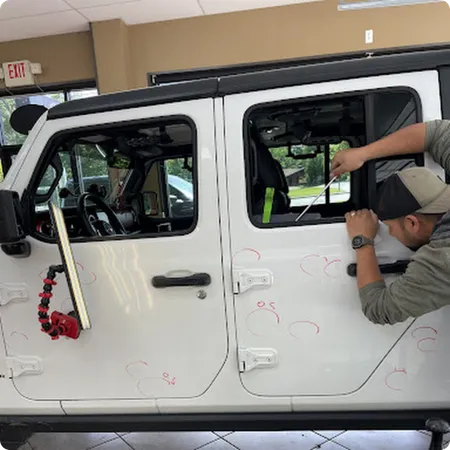
Every hail repair at Precise Dent Repair starts with a detailed inspection under bright, angled lighting. We map each individual dent across every panel, then check the paint and metal for chips, cracks, or stretched spots. A severe hail job can involve dozens or even hundreds of dents, so this mapping stage shapes the entire plan and ensures nothing is missed.
We prioritize panels by severity and accessibility. Where tools can reach behind the metal, we use push from behind techniques with specialized rods to coax each dent back to level. Where braces or seams block access, we switch to glue pulling, drawing the dent out from the surface. Blending hammers refine the finish, and controlled heat helps on stubborn or aluminum panels.
The payoff is speed and preservation. Paintless dent repair successfully corrects between 80 and 90 percent of hail damage cases while keeping the original factory paint untouched. Most hail jobs finish in one to two days, compared with five or more days at a traditional body shop. That means less time without your vehicle and no repainting that can affect resale value.
When Paintless Repair Is The Right Call
Paintless dent repair handles dents up to roughly 4 inches wide and 1.5 inches deep, the shallow to medium rounded indentations that typical hail leaves behind. The severity rating runs through nine levels, from very light at one to five dents per area up to ceiling grade at 201 to 250 dents per area.
The method has limits worth knowing. It cannot restore cracked, chipped, or peeling paint, extremely sharp creases, stretched metal, or very large dents beyond 6 to 8 inches. If a storm's hail was oversized or heavily wind driven, it may stretch metal past what we can safely move, and those panels need traditional bodywork.
Modern vehicle construction adds another layer. Ultra High Strength Steel above 600 to 700 MPa is effectively a no repair zone because the metal is too hard to move and may crack. Aluminum panels dent more easily and demand different tools and pressure, while pre existing chips, UV wear, or thin clearcoat raise the chance of paint cracking.
This is why every severe hail case deserves individual evaluation rather than a one size answer. When we inspect your vehicle, we are reading the story the storm left: the dent depth, whether metal has stretched, how the paint responded, and whether impacts clustered or spread evenly. Cracked, chipped, or peeling paint is the clearest warning that paintless repair alone will not finish the job, and we tell you that plainly rather than start work that cannot deliver a flawless result.
Where damage mixes repairable dents with panel warping or structural movement, we combine paintless techniques with conventional body repair so you get the best of both. Our goal is always to preserve as much original factory finish as the damage allows, because that finish protects your warranty, your appearance, and your resale value. Honest assessment up front saves you time, protects your vehicle, and makes the insurance conversation far simpler when claims follow a major storm.
Frequently Asked Hail Damage Questions
What size hail dents cars in Texas? Even small stones leave a mark. Hail from 0.25 to 0.50 inches, pea to marble size, causes minor cosmetic dents. At 0.75 to 1.00 inch, penny to quarter size, dents become noticeable but usually stay paintless repairable. From 1.25 to 1.75 inches, half dollar to golf ball, damage turns significant with possible paint harm. Texas has seen stones up to 6.4 inches, so severity varies dramatically by storm.
When is hail season worst in Texas? Statewide, expect the greatest risk from March through June, with a secondary fall peak. The timing marches north to south, so Amarillo peaks in April and San Antonio in May. The Panhandle gets a second round in September and October from southbound cold fronts. Because the season appears to be lengthening, it is wise to stay prepared earlier in spring and later into autumn than in past years.
Can paintless dent repair fix all hail damage? Not every case, but most. We successfully repair 80 to 90 percent of hail damage while keeping the factory paint intact, since hail typically leaves rounded dents without creasing or cracking. The method cannot fix cracked paint, stretched metal, very large dents, or ultra high strength steel panels. That is why we inspect every vehicle individually and recommend combined repair only when the damage genuinely requires it.