





The Texas Hail Reality
Texas leads the nation in hail exposure, and the numbers keep climbing. In a single recent year, one major insurer paid well over a billion dollars in Texas hail claims, more than any other state and sharply higher than the year before. Storms today arrive more often, drop larger stones, and cause more damage than the ones a generation ago ever did.
For Austin drivers, the danger concentrates from March through June, when a single afternoon storm can hammer multiple zip codes at once. After every big event across DFW and North Texas, the repair scramble begins, and how you handle it decides whether you spend weeks and real money at a body shop or restore your vehicle quickly with paintless dent repair that preserves its factory finish.
The Body Shop Process, Step By Step
Traditional bodywork is labor intensive by design. A technician sands the damaged area, packs the low spots with body filler, then sands again to rebuild the original contour. That reshaped section gets primed, painted, and blended to match the rest of the panel. Every one of those stages demands materials, skilled hours, and paint booth time that paintless methods never touch.
The car does not move through that process in one motion. It cycles through disassembly, filler application, sanding, primer, paint, curing, reassembly, and a final quality check. Each stage carries its own wait time, because filler must harden and paint must cure before the next step can begin. Nothing overlaps, so the hours stack up and the invoice grows with them.
Shops also charge for time in the paint booth and for disposing of hazardous waste generated by filler dust, solvents, and overspray. Those are unavoidable costs of the refinishing method itself. When you multiply a single dent workflow across dozens of hail dings spread over a hood, roof, and both fenders, the total climbs fast compared to a paintless approach.
Hidden Costs That Follow The Repair
The first estimate rarely tells the whole story. Once a shop opens the panels, additional charges called supplements surface. Broken molding clips, new trim pieces, weatherstrips, and even replacement outer panels on hoods and roofs all get added after work begins. These are the costs no one warns you about at drop off, yet they land squarely on the final bill.
Downstream expenses continue long after you drive away. Over the following year, owners often pay for detailing to remove overspray that settled on glass and rubber, plus touch ups for fresh chips and cracks where new paint failed to cure or adhere as well as the factory finish. Refinished panels simply do not hold up the way original clear coat does.
Then there is color matching. Blending is strongly recommended for metallic, pearl, and tri coat finishes, where a hard edge between old and new paint would be obvious in direct sunlight. Achieving that seamless transition takes extra time, materials, and skill. It is a real cost body shops must absorb and pass along, and paintless dent repair never incurs it at all.
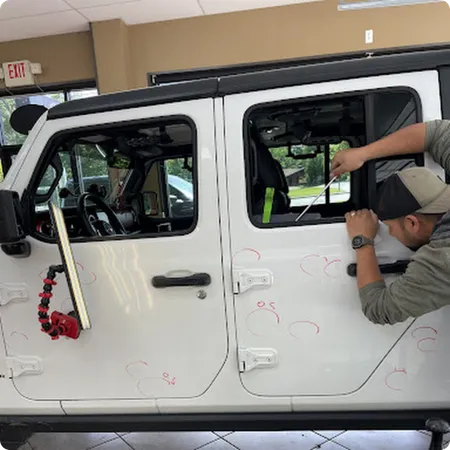
Paintless dent repair sidesteps this entire chain because it works from a completely different principle. Rather than cutting into your paint, a technician accesses the back side of each panel through existing body openings, sometimes after removing trim, a door card, or the headliner. Using rods that range from roughly six inches to five feet long, the metal is massaged back to its factory contour one dent at a time. There is no sanding, no filler, no primer, and no paint, so the materials and hazardous waste that drive body shop invoices simply never enter the equation.
On double walled panels where a rod cannot reach the reverse, our technicians bond a small tab to the outer skin with hot melt glue, draw the dent out with a slide hammer, then tap down any high spot until the surface reads flat. Because the factory paint stays fully intact throughout, there is nothing to color match and nothing to cure. Fewer materials and faster continuous work translate directly into a lower overall cost, which is exactly why insurers have favored the method for years.
Timelines And Downtime Compared
Time is money, and hail repair proves it plainly. Paintless dent repair typically takes one to three shop days for moderate hail damage, because a technician works panel by panel without pausing for anything to dry, cure, or be color matched. The repair process stays continuous from the first dent to the last, and your vehicle comes home before the week is out.
The same moderate damage at a body shop runs two to four weeks, driven entirely by the strip, fill, sand, prime, paint, and cure cycle. When damage requires a combination of paintless work and traditional bodywork, expect one to two weeks. Severe hail involving panel replacement and extensive paintwork can stretch across several weeks, especially when parts must be ordered in.
Those weeks are not just abstract calendar days. Four weeks in a body shop is four weeks of arranging a rental or loaner, and possibly paying out of pocket if your policy caps the daily rental allowance. After a widespread storm, shop backlogs grow because each vehicle occupies the booth longer, pushing appointment and completion dates even further out.
Resale Value And Vehicle History
Lorem ipsum dolor sit amet, consectetur adipiscing elit. Integer posuere pretium fermentum magna. Curabitur accumsan neque sit justo dictum, eros sem placerat arcu, non tincidunt nibh nulla ut sem.
Morbi dignissim sapien vel ipsum accumsan, in fringilla velit varius. Proin posuere nunc sed elit auctor, non molestie magna facilisis. Vestibulum laoreet magna imperdiet interdum, non tristique justo varius.
Maecenas tempor magna nec metus efficitur, vel placerat velit vulputate. Vivamus gravida semper elit eget tincidunt. Proin consequat luctus ipsum, non malesuada nunc ultrices vitae.
How your car is repaired follows it for the rest of its life. When a body shop replaces a panel, repaints a panel, or performs structural work, its licensing agreement requires that work to be reported, and the record stays searchable on every CARFAX or AutoCheck report ever pulled on that VIN. Buyers and dealers read a body repair flag as prior damage, and dealers commonly discount a flagged vehicle by roughly five to fifteen percent at trade in.
Paintless dent repair leaves no such trail. Because the factory paint is preserved, nothing shows up on a paint thickness gauge, the tool dealers and savvy private buyers use to spot repainted sections. There is no refinishing, no panel replacement, and no structural work to report, so no body work appears in the vehicle history unless the insurance claim itself was reported. Done correctly, paintless dent repair restores panels to factory condition and keeps the value impact minimal.
Insurance, Storm Chasers And When Bodywork Is Needed
Hail is treated as an Act of God comprehensive claim, not an at fault accident. If you carry comprehensive coverage, hail damage repair is generally covered, though basic collision or liability policies will not pay for it. Under Texas Insurance Code Chapter 1953, insurers are prohibited from raising your premium based solely on a claim for loss caused by natural causes, so filing does not punish you.
You are never locked into a steered shop. Texas policyholders may select any licensed repairer they choose, which means you can bring your vehicle to a paintless dent repair specialist rather than the body shop your insurer suggests. Because paintless repair costs far less than traditional work, it keeps more vehicles under the total loss threshold, protecting owners from a salvage title and the worst case resale outcome.
Not every dent qualifies for paintless work, and we will tell you honestly when it does not. Cracked paint, deep or sharp dents, stretched or torn metal, and structural damage all require traditional filler, primer, and refinishing. Aluminum panels are harder to reshape and often push time and cost higher. Beware storm chasers who set up in parking lots after a storm, offer quick cash deals, and vanish before their work can be judged.