





Cosmetic Versus Structural Roof Dents
If you own a vehicle in Texas, hail is not a question of if but when. Texas leads the nation in major hail events, with a storm corridor running from the Panhandle through North Texas, Dallas Fort Worth, and into Central Texas and the Hill Country. Most of these storms strike between March and June, and the roof of your vehicle is almost always the panel that takes the worst of it.
The roof is a large, flat, horizontal surface with no angle to deflect falling ice, so it catches hail at full terminal velocity. One storm can leave dozens or even hundreds of small dings scattered across the roof, hood, trunk, and upper door panels. The good news is that these are exactly the kinds of dents paintless dent repair was built to fix, and most roof dents are completely repairable.
How We Repair A Hail Damaged Roof
The single most important factor in a roof repair is whether the paint is intact. When metal is dented but the factory finish and clearcoat are unbroken, the damage is almost always cosmetic. It does not affect safety or weatherproofing, and paintless dent repair becomes the least invasive path to restore the panel to its original shape.
Problems begin when hail is large enough to crack the clearcoat, chip through to primer, or break the paint entirely. At that point the metal may still be repairable, but repainting becomes necessary, and traditional body shop work may make more sense. Severely stretched metal and deep, sharp creases also push a panel past what paintless methods can fully correct.
Hail size is a useful guide here. Quarter size hail around one inch is the general threshold for visible denting on roofs and hoods. Golf ball size hail near 1.75 inches causes significant multi panel damage. Baseball size hail around 2.75 inches can cause severe structural damage and almost certainly breaks glass. We assess every panel individually before recommending an approach.
When PDR Is Not The Answer
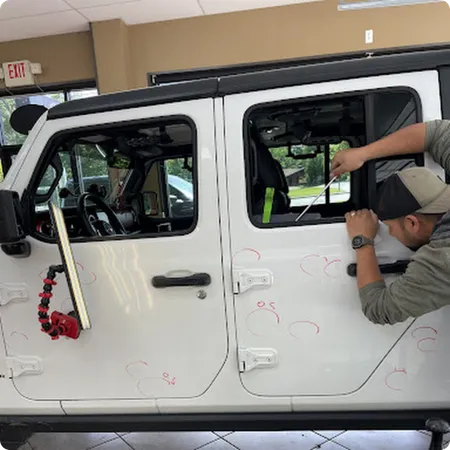
Every roof job starts with assessment. We use line boards, fog boards, and LED lighting to read the metal, pinpoint each crown and low spot, and confirm the paint and clearcoat are intact. This tells us whether the deformation stays within repairable limits before any tools touch the panel.
When the headliner can be removed, accessing the back of a roof dent is fairly straightforward. We perform strategic interior trim removal, then use extended reach rods up to 36 inches to reach behind each dent and gently massage the metal back into place until there is no sign it was ever there.
For braced areas where we cannot reach behind the panel, we rely on glue pull techniques. Custom designed tabs are attached to the outside of the dent, pulled with a controlled tool, then released cleanly. We finish with tap down refinement and a final multi angle quality inspection under precise lighting.
Panel material changes our approach. Many modern vehicles now use aluminum roofs, and aluminum behaves very differently from steel. Steel panels have natural metal memory that helps them return toward their original shape as we work. Aluminum lacks that memory and requires a slower, more controlled technique with different tooling to coax each dent out without overworking the metal. This is one reason two vehicles from the same storm can take different amounts of time to repair, even when the dent count looks similar from the driveway.
Throughout the entire process, our goal is to preserve the original factory finish and its built in UV protection. Paintless dent repair uses no fillers, no sanding, and no repainting, which means your vehicle keeps the exact paint it rolled off the line with. That matters for appearance today and resale value later, because factory finishes carry no color match risk and do not raise the flags that repainted panels often create in vehicle history reports. Preserving that original coat is the whole point.
What To Do After A Storm
Paintless dent repair handles the vast majority of hail damage, but it is not a cure all. The method depends on an intact paint surface. When the finish is broken, repainting is required regardless of how well the metal responds, which means paintless work alone cannot fully restore the panel on its own.
A simple rule of thumb helps. If a dent is smaller than a quarter, shallow, sits on an open flat area, and the paint is unbroken, paintless repair has an excellent chance of restoring it completely. Sharply stretched dents, torn metal, or cracked clearcoat move the job toward hybrid repair or conventional bodywork instead.
We will always tell you honestly which category your roof falls into. Sometimes the right answer is a combination, with paintless repair handling most dents and a spot repaint addressing the few areas where paint broke. Being straight about this is part of how we protect both your vehicle and your trust in our work.
Insurance And The Texas Claim Angle
Hail damage falls under comprehensive coverage, not collision. Comprehensive insurance covers weather events including hail, falling objects, and flooding. If you only carry liability, there is no coverage for hail, and in Texas roughly half of all drivers have no comprehensive protection at all.
Filing a single hail claim is generally safe. Hail is treated as an act of nature, and most insurers do not raise individual rates for one comprehensive claim. If an entire city sees a high volume of ongoing claims, insurers may adjust rates across that whole area rather than targeting you specifically.
Paintless dent repair is the recognized standard for hail work, and all major insurance companies approve it because it is both effective and efficient. We handle direct insurance billing, which keeps the process simple and lets us coordinate with your adjuster so your repair moves forward without unnecessary back and forth.
After a storm, documentation protects your claim. Safely inspect your vehicle from the ground, then photograph every panel including the roof in natural daylight so the dimples show clearly. Look at your home as well, because gutters and downspouts are soft metal that dents easily. Visible denting on them is a reliable sign the hail was large and fast enough to damage your vehicle, and adjusters often use that gutter damage as a reference point when evaluating storm intensity for your area.
Timing matters more than most people expect. Severe hail events can create months long repair backlogs across the region, so scheduling quickly after a storm gets you in before the rush builds. Be cautious of out of state pop up shops that appear after big Texas storms. Choose a local, established business with verifiable reviews and a real Texas presence so you know someone will stand behind the work long after the storm chasers have moved on to the next city.
Common Questions About Roof Hail Dents
Can hail dents on a roof really be fixed without repainting? In most cases, yes. As long as the paint surface is intact and the headliner or trim can be removed for access, paintless dent repair restores roof dents by working the metal from behind or with careful glue pulls. The factory finish stays exactly as it was, with no fillers, no sanding, and no color match concerns to worry about later.
How long does a hail damaged roof take to repair? It depends on the dent count, the panel material, and how much interior trim must come out for access. Many vehicles that are good candidates are finished in hours to a day or two. Extensive damage with hundreds of dents, aluminum panels, or heavy trim removal can take up to a week of focused work to complete properly.
Why did my neighbor get repaired faster than me? Two vehicles from the same storm rarely match. A steel roof with a modest number of shallow dents comes out quickly, while an aluminum roof, a higher dent count, or extensive headliner and trim removal all add time. We size up every vehicle individually so the estimate and schedule reflect the real work your specific roof needs.