





Why Truck Beds Get Hit Hardest
If your truck sat through a Texas hailstorm, the bed likely took the worst of it. A pickup is more vulnerable to hail than a passenger car, and not because of its size. The bed is a wide, near horizontal metal panel with no curved geometry to deflect impact. Every hailstone lands almost perpendicular to that flat surface, so the full kinetic energy transfers straight into the metal.
The good news is that this same flat, expansive design makes truck beds excellent candidates for paintless dent repair. Large body panels have less structural support underneath, so they flex and dent more readily than the reinforced curves of a car body. That accessibility lets a technician reach behind the panel and gently massage each dent back into shape, restoring the metal without touching your factory paint.
How Paintless Dent Repair Works
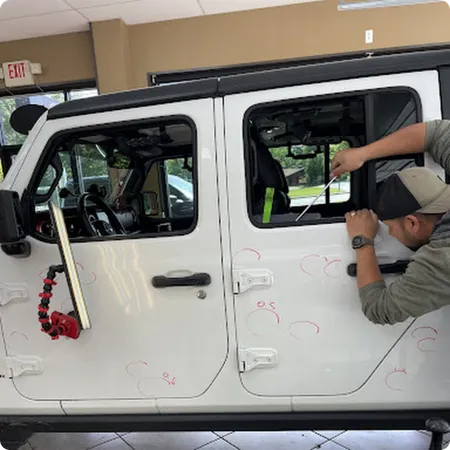
PDR is a specialized process that reshapes damaged metal while preserving the vehicle's original factory paint. Instead of filling, sanding, and repainting, a technician uses metal rods, body picks, and controlled lighting to work each dent from the underside. Applying precise, patient pressure, they gradually coax the panel back to its original position with no harsh chemicals involved.
The science behind it is metal memory. Metal naturally wants to return to the shape it held before the hailstone struck, so a skilled hand guides it there rather than forcing it. Hail damage is especially suited to this approach because most hail dents are shallow, rounded depressions with clean, defined edges and paint that stayed intact on impact.
Every job starts under controlled lighting, where the technician maps shallow and deep dents, crease damage, stretched metal, and any paint chips. Interior trim or inner bed panels may be gently removed for backside access. When direct access is limited, glue pulling from the exterior is the better option. Once every dent is leveled, panels are rechecked under lights and the truck is cleaned to a factory fresh finish.
What About My Bed Liner
This is the question nearly every truck owner asks, and it is a fair one. Many worry that repair means tearing out a spray in liner or compromising the bed's durability. In most cases, that fear is unfounded. A high quality liner can usually stay right where it is.
Our technicians use specialized tools and lighting to access and repair most bed dents from underneath, often without disturbing a spray in liner at all. That preserves both the look you paid for and the hard working functionality you depend on for hauling, so your truck keeps doing its job.
When a liner or trim does need brief removal to reach a stubborn dent, we handle it carefully and reinstall everything before you pick the truck up. The goal is always the same: repair the damage completely while keeping your truck looking and working exactly as it did before the storm.
Not every dent is a candidate, and honesty about that matters. PDR works when the dents are visible but the paint surface is intact and unbroken across the entire dent. A common rule of thumb is that if a dent is smaller than a quarter with clean paint, the panel has an excellent chance of full restoration. Skilled PDR can address the vast majority of dents caused by pea sized hail or road debris, and because the factory finish is never touched, your truck keeps its original, best paint.
Conventional repair becomes necessary in specific situations: when paint has cracked or chipped, when the metal is stretched or sharply creased beyond what PDR can safely restore, or when the size, location, or complexity of a dent prevents an effective result. Previous body work can also change how a panel behaves, making PDR unreliable. Poor technique carries real risk too, producing high spots, cracked paint, or visible waves. That is why the technician matters far more than the tools they hold.
Steel Versus Aluminum Truck Beds
The panel material on your truck changes everything about the repair. Steel beds respond well to PDR because the metal reshapes predictably under controlled pressure. Modern trucks increasingly use aluminum panels, and aluminum is a different animal entirely. It is harder to reshape than steel, which makes the process more demanding and, depending on dent severity, sometimes ineffective.
This is not a minor distinction. A large share of technicians who competently repair steel panels cannot work aluminum to an acceptable standard. Aluminum holds its shape more stubbornly, resists the gentle massaging that steel accepts, and punishes any lack of experience with visible imperfections. Repairing an aluminum bed correctly requires specific training and a lot of practiced patience.
Before you trust anyone with an aluminum bodied truck, it is worth confirming they routinely work that material. We assess the metal type as part of every inspection so the right approach is matched to your specific truck. Getting this right the first time protects both the panel and the long term value of your vehicle.
Checking Your Truck Before You Call
You can do a quick self check before scheduling. Walk around your truck in direct sunlight and study the center of each hail impact point on the bed and cab. You are looking for one thing above all: the condition of the paint at the deepest part of the dent.
If you spot white or silver paint chips at the center of an impact, the paint cracked when the hailstone hit, and that specific area is not PDR eligible. Intact paint over a smooth, rounded depression is the green light. This single indicator is the most reliable clue about whether a panel can be saved without refinishing.
Do not worry about counting every dent or diagnosing severity yourself. A quick look tells you whether the paint held, and that is the gating factor. Bring us anything you are unsure about, since dense clusters and shallow sleeper dents are easy to miss with an untrained eye under poor light.
Timing also matters more than most owners expect. Texas sits squarely in hail country, with more than 1,200 hailstorms recorded between 2012 and 2021 and 529 hail events in 2024 alone, a sharp jump over the prior year. North Texas around Dallas Fort Worth and Wichita Falls sees the most storms, while West Texas gets frequent severe hail along dry lines. Spring peaks hardest, with April historically the worst month, followed by a secondary fall peak.
Because major storms hit whole regions at once, every hail event produces a surge in repair demand across the area. Booking promptly gives you the shortest wait before your truck can be scheduled, and it also protects the vehicle. Hail damage is not purely cosmetic. A single neglected dent on the cab or bed can develop into rust, water intrusion, and more extensive repairs down the road, so addressing it early is always the smarter move.
Insurance, Value, And Peace Of Mind
Insurers around the world have recognized PDR as the preferred method of repair for hail damage, and for good reason. It preserves the original finish, reduces repair time, and avoids refinishing an otherwise undamaged panel. Hail falls under comprehensive coverage, which applies to weather related damage like hail, falling branches, and flooding rather than collision events, so filing a claim for storm damage on your truck is typically straightforward.
There is a resale advantage worth understanding too. Because PDR does not involve body filler or repainting, it does not register on a vehicle's Carfax report the way a typical collision shop repair does. Your truck keeps its clean history and its original factory paint, both of which support long term value. That combination of an untouched finish and an unblemished record is difficult to match with conventional bodywork.
Repair time depends on the extent of the damage. A few isolated dents can often be handled in hours or a single day, while a full size truck with dense clusters across multiple panels may take 2 to 3 days, especially when trim removal or prep is needed first. Aluminum and any required paint work add time. We give you a realistic timeline after inspecting the truck so you can plan around it with confidence.