





Why Texas Hail Deserves Your Full Attention
Texas records more severe hail events than any other state, and the Dallas Fort Worth metroplex sits squarely in the crosshairs. We live in what meteorologists call hail alley, where dry western air collides with moist Gulf air to spawn supercells that drop golf ball sized ice. A single storm can leave a hood, roof, and trunk looking pockmarked in under ten minutes, so knowing what to look for matters.
Peak hail season runs March through June, with a secondary spike in September and October, and Texas averages well over 120 hailstorms a year. That recurring threat means dent damage is rarely a one time problem here. The good news is that most hail leaves rounded dents without breaking the factory finish, which is exactly the territory where Paintless Dent Repair delivers clean, invisible results without repainting your vehicle.
The Panel By Panel Self Inspection
Start your inspection with the surfaces that face the sky. The roof is almost always the hardest hit panel and the easiest one to overlook, so check it first, then move to the hood and the trunk lid. Hail falls straight down onto these horizontal panels, concentrating dents where you might not naturally look at eye level.
Next, work the vertical surfaces: doors, side panels, and the tops of the front fenders. Because of wind direction during a storm, one side of your vehicle is often heavily damaged while the other stays nearly untouched. Look for rounded dents, typically 10mm to 40mm across, clustered rather than uniform, since hail rarely lands in a neat repeating pattern.
Finish with the details that many owners miss. Check mirror caps for looseness, trim pieces for fresh impact marks, and the clear coat for stress around the edges of a hit. Then inspect your windshield, windows, and mirrors for cracks or breaks. Good lighting helps enormously, so inspect in bright daylight or use an LED strip to throw shadows that reveal dent depth.
Green Light Versus Red Light Damage
The single most important thing you can assess is whether your factory paint is still intact. Run a fingertip over a dent. If the surface feels smooth, unbroken, and firmly attached, that is a strong green light for Paintless Dent Repair, which reshapes the metal from behind without touching the finish.
Red light damage demands immediate escalation. Cracked or broken glass needs urgent attention because cracks spread quickly and glass can shatter. Broken paint exposes bare metal that will begin to rust, and sharply creased or heavily stretched metal often shifts the repair path toward conventional bodywork and refinishing rather than PDR alone.
One common misconception: chips in a windshield are not caused by hail. Hail does not chip glass, it breaks it. Small chips almost always come from rocks or road debris. If you see genuine cracks or a shattered pane after a storm, treat that as a safety priority and schedule glass replacement right away.
Our repair decision usually comes down to three things: paint condition, dent shape, and panel access. When the paint is intact and the dents are rounded on accessible panels like the hood, roof, trunk, and upper doors, Paintless Dent Repair is the superior solution and handles an estimated 80 to 90 percent of hail damage. It is also the insurance preferred method because it preserves the original factory finish, keeps your repair record clean, and moves far faster than a body shop, often finishing within a few hours to a couple of days rather than a week or more.
When paint has already broken open, when a panel is badly stretched, or when the structure underneath has shifted, traditional body repair becomes the safer long term choice. Large hailstones can occasionally cause structural damage that requires comprehensive repairs, and if we find rust, sharp creases, or broken finish, we may recommend refinishing, windshield or glass replacement, or a structural check. Our job is to tell you honestly which path protects your vehicle, and we walk you through exactly why so you understand the reasoning behind every recommendation.
Why Waiting Costs You More Later
Damage to paint or glass genuinely cannot wait. Exposed metal begins to corrode, and glass cracks spread until the pane fails. But even PDR eligible dents deserve prompt action. Experts recommend addressing hail damage within 2 to 4 weeks of the event, before Texas summer heat and time work against a straightforward, invisible repair.
Two or three months of summer exposure can push a vehicle out of easy PDR territory and into a repair that requires paint correction or panel repainting. That outcome costs more, takes longer, and leaves a repaint record on your vehicle history that reduces resale value. Untreated dents that begin to rust can turn a simple fix into a full bodywork restoration.
There is also an insurance risk to delay. If another hailstorm hits before your first round of damage is repaired, your insurer may treat the new dents as pre existing and decline coverage. In a state that averages over 120 storms a year, a second event is not a remote possibility, so closing out the first claim quickly protects your coverage.
The Appointment Rush After Big Storms
Repair demand spikes fast after a large regional storm, and calendars fill quickly. When an entire DFW neighborhood gets hit in the same ten minutes, every affected driver starts calling at once. Acting promptly protects both your vehicle and your place in the schedule before the rush.
Prompt scheduling also lines up neatly with insurance timing. Reporting your claim within 24 hours of a storm dramatically improves both approval timelines and settlement outcomes in the current Texas environment. The sooner your inspection happens, the sooner your paperwork moves and the sooner your repair slot is locked in.
A word of caution from the Texas Department of Insurance: not every repair company that reaches out after a storm is legitimate. Storm chasers follow hail events and pressure homeowners into rushed decisions. Choose an established, local shop with real certifications and a track record you can verify before handing over your keys.
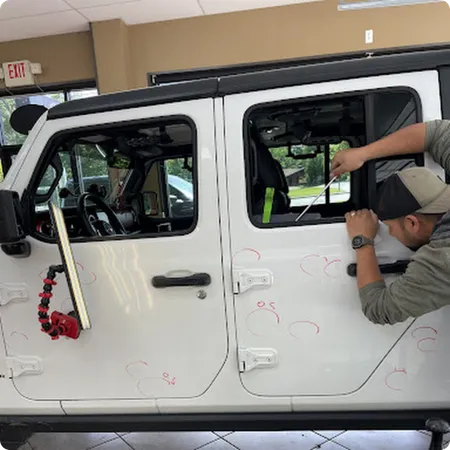
Before your professional inspection, document everything. Capture panel wide photos and close ups in bright light, and use a coin or ruler beside a representative dent for scale. A reflection off a line board or LED strip highlights dents that are nearly invisible in flat light, revealing depth and shape the way a trained inspector would see them. This self documentation gives you a clear record of the storm's date and the damage's condition, which supports your claim and helps separate genuine hail damage from ordinary wear and tear later.
When you bring the vehicle to us, our assessment goes further. We position specialized lighting at multiple angles to cast shadows across each panel, then count dents, sometimes on a grid, and measure the diameter and depth of representative hits to gauge severity accurately. That documentation carries weight with insurers, and because certified inspection work is taken seriously by adjusters, a thorough report often smooths approval. We confirm which panels qualify for PDR and which, if any, need a different repair method before any work begins.
Insurance, Coverage, And Common Questions
Does insurance pay for hail damage? If you carry comprehensive coverage on your auto policy, the Texas Department of Insurance confirms your company should pay for hail damage. Note that hail claims fall under comprehensive coverage, not collision. Most insurers require you to report hail damage within 30 days of the storm, though reporting within 24 hours produces the best approval timelines and settlement outcomes, so do not sit on it.
Will PDR hurt my resale value? No. Correctly performed Paintless Dent Repair has minimal impact on resale because it preserves your original factory finish and leaves no repaint record. By contrast, hail damage left untreated, or a repair that requires repainting, can reduce a vehicle's resale value meaningfully. A clean PDR repair keeps your vehicle history intact, which is precisely why insurers prefer this method for eligible hail damage.
How long does a hail repair take? A typical Texas timeline runs about 5 to 14 days total: an initial inspection of roughly 30 to 60 minutes, a couple of business days for insurance approval, then the actual repair, which for PDR is often just a few hours to a couple of days depending on how many dents each panel carries. Traditional bodywork takes considerably longer, another reason PDR is the faster, cleaner choice when paint is intact.