





Why Windshield Damage Hides
Living in Texas means living inside Hail Alley, where warm Gulf air slams into cold fronts and fires up some of the largest, most frequent hailstorms in the country. Texas averages hundreds of hailstorms every year, and storms that spin up in West Texas often mature into supercells by the time they reach Tarrant and Dallas counties, driving the highest concentration of auto hail damage claims anywhere in America.
Your roof, hood, and trunk usually show hail damage clearly, but your glass tells a quieter story. Windshield damage is often subtle, showing up as a faint chip, a small ding, or a hairline crack that many drivers never notice until weeks later. When Texas summer heat hits that stressed glass, a chip you missed can suddenly spread into a full crack across your line of sight, so learning to spot it early truly matters.
Laminated Versus Tempered Glass
Your windshield is laminated glass, meaning two panes are bonded to a flexible polyvinyl butyral interlayer. That construction is exactly why hail chips and cracks it instead of shattering it. Typical hail damage on a windshield looks like small bullseyes, star breaks with short legs radiating outward, or surface pitting where dozens of tiny stones sandblasted the surface without punching through.
Side and rear windows are a completely different animal. They are tempered glass, engineered to crumble into small rounded pebbles rather than break into dangerous shards. Tempered glass does not do partial damage. Either the hailstone bounced off and left the window intact, or you have a seat full of glass pebbles. There is no repairing a tempered window; if it broke, it needs full replacement.
Understanding this difference helps you know what you are looking at after a storm. On the windshield, hunt for chips, stars, and pitting that may still be repairable with resin. On the doors and rear glass, the question is simply whether the pane is intact or gone. Hail chips also tend to be shallower than road debris chips and often spider into small surface cracks.
How Hail Size Changes Everything
Size drives a lot of the outcome. Marble sized hail typically causes small chips and light surface pitting, mostly cosmetic. Once you reach quarter sized hail and larger, the outer glass layer can crack or shatter, and in severe storms the inner laminated layer cracks too, turning a minor annoyance into a safety concern that demands attention.
Speed matters as much as size. Smaller hail falls around 9 to 25 miles per hour, hail in severe thunderstorms falls at 25 to 40 miles per hour, and large supercell hail can plummet at 44 to 72 miles per hour. Faster, denser stones hitting glass at a steep angle deliver far more destructive energy than their diameter alone suggests.
Size is never the sole factor. The velocity and density of the hailstone, the angle of impact, and the underlying strength of the glass all combine to determine whether you walk away with a harmless pit or a spidering crack. Texas has recorded stones over six inches across, and hail that large reshapes both metal and glass in seconds.
When you inspect your own vehicle after a storm, work methodically and start with the surfaces facing the sky. Hail generally falls vertically, so damage concentrates on horizontal panels like the roof, hood, and trunk, and is often absent from vertical doors and quarter panels unless high winds drove the stones sideways. The roof is usually the hardest hit panel and the easiest to overlook, so climb up or use a ladder to view it straight on. Uniform denting across the hood and roof but not on the doors strongly points to hail rather than another cause.
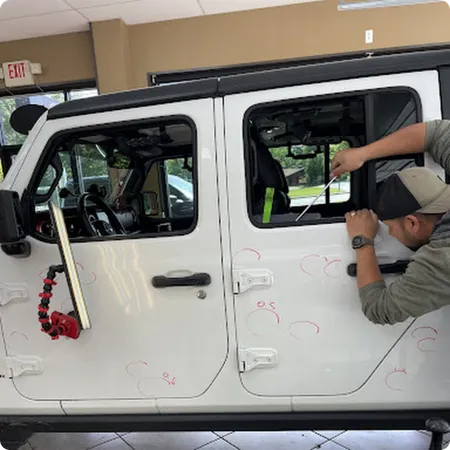
To catch subtle dents on flat panels, run your forearm across the surface while viewing it edge on. If the reflection of your arm wobbles or appears distorted, a dent is hiding there. Do the same for your glass, tilting your view so raking light rakes across it and reveals chips and stress points invisible under flat lighting. Our technicians use specialized PDR lights and oblique lighting that expose the faintest impacts, including damage on the windshield pillars where deflected hail energy travels into the narrow steel channel beside the glass.
Hidden Damage You Might Miss
The damage you can see is rarely the whole picture. Windshield pillars are commonly missed because glass deflects hailstones and pushes that impact energy into the slim steel channel alongside the windshield, creating micro dents. Catching and repairing those pillars early prevents rust from forming, which protects the bond your windshield relies on for any future replacement.
After a hard storm, hidden moisture damage becomes a real threat. We check under the hood for compromised seals that could let water intrude into electrical connections, the air intake system, and engine compartment seals. What starts as a cosmetic hail event can quietly turn into corrosion or electrical trouble if that intrusion goes unnoticed for weeks or months after the storm passes.
Small existing chips are another trap. Neglecting a coin sized chip invites disaster, because the next hailstorm magnifies that weak point into a large crack requiring full replacement instead of a quick resin repair. Each chip is a stress concentration point, and Texas temperature swings from cold mornings to hot afternoons repeatedly flex the glass until small chips spread within days.
Repair, Replace, Or Recalibrate
Location and size guide the decision. Small chips about the size of a coin or smaller are frequently repairable with resin, which is a genuine strength restoring fix rather than a cosmetic patch. Larger cracks or multiple impact points usually push you toward replacement instead of repair.
Where the damage sits matters just as much. Anything directly in the driver's line of sight or near the edges of the windshield typically warrants replacement, because those areas affect both visibility and the structural bond. A resin repair done early stops a chip from ever becoming a crack that spans your view.
This is not just about looks. Your windshield supports a large share of your vehicle's structural integrity, carrying much of the load in a front end collision and even more in a rollover. Hail that cracks or breaks the windshield compromises roof strength, so timely repair or replacement is a genuine safety decision.
If your windshield does need full replacement, the job is not finished when the new glass is set. Most modern vehicles equipped with forward collision warning or lane keeping assist mount a camera behind the windshield, and replacing the glass triggers mandatory forward camera recalibration. Skipping that step leaves your safety systems misaligned, meaning lane keeping and automatic braking may read the road incorrectly. We treat recalibration as a non negotiable part of any windshield replacement so your driver assistance features work exactly as the manufacturer intended.
For the metal panels, paintless dent repair is the preferred solution across the vast majority of mild to moderate hail damage, provided your factory paint remains intact. Our skilled technicians access the backside of each panel and use custom crafted tools to gently massage and push the metal back to its original shape, preserving your original finish. Where hail chipped paint down to bare metal, we address those spots with careful sanding and repainting so no exposed steel is left to rust.
Texas Insurance And Timing
In Texas, hail damage is covered by comprehensive coverage, not collision, because hailstorms are classified as acts of God that fall outside collision claims. If you carry comprehensive, your windshield chips, cracked glass, and dented panels are generally eligible. Filing a comprehensive claim for an act of nature typically does not raise your individual premium, though general rates across a storm prone region may climb for everyone over time as claims accumulate.
Timing is critical, so do not wait. The legal statute of limitations for a hail claim in Texas is two years from the date of the storm, but most policies include a prompt notice clause, and filing within 30 days is the strongly recommended standard for Texas drivers. Your carrier must acknowledge the claim within fifteen days of notice and accept or reject it within fifteen business days of receiving all required information from you.
The smartest move is a fast, thorough inspection once the storm has fully passed and the roads are safe. Documenting every chip, pit, crack, and dent right away protects both your claim and your vehicle before summer heat spreads hidden damage. Our team can walk your car panel by panel, identify what qualifies for paintless dent repair versus glass work, and help you move quickly while your claim window is still wide open.