





Understanding Curves And Edges
Paintless Dent Repair removes small dents, dings, and minor collision damage from a vehicle body whenever the paint remains unbroken. Our technicians reach behind the panel with specialized rods and levers, gently massaging the metal back to its original shape without disturbing the factory finish. This method works on both steel and aluminum panels, and it handles hail damage, door dings, creases, and body line hits beautifully.
The question we hear most often is whether curved panels and sharp edges are off limits. The honest answer is that it depends on where the damage sits and how badly the metal moved. Gently curved surfaces are ideal territory, while rolled edges and crushed body lines push against physical limits. Below, we break down exactly what PDR can and cannot correct on contoured metal.
The Curved Panel Spectrum
Not every curve behaves the same way under a tool. A gently curved door skin or hood is prime territory for PDR because the round edges of a dent let us apply even, controlled pressure and coax the metal back to contour. Shallow, smooth dents from other car doors, sports equipment, or falling objects lift out cleanly.
Sharply curved areas such as wheel arches and A pillars are a different challenge. The metal here is stiffer, the geometry is less forgiving, and backside access grows tight. Repair is still frequently possible, but it demands more patience, careful light reading, and often a blend of push work and glue pulling to reshape the panel without overpushing.
Body line creases sit at the demanding end of the spectrum. These deliberate ridges are stamped with work hardened metal, so an impact disrupts the engineered stress patterns that keep the line crisp. Shallow creases where the metal has not been severely stretched often return to form, while deep, folded creases carry high tension that must be released in a precise sequence.
Why Curves Behave Differently
The foundation of PDR is accessing a dent from behind through natural openings and redistributing stress evenly across the panel. This relies on the metal's natural memory and rebound. On a gentle curve, that memory works in our favor, letting the surface settle back toward its original arc with steady, measured pressure.
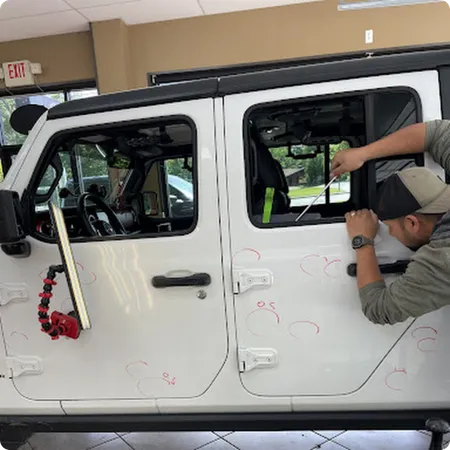
To read a curved surface accurately, our technicians shine a bright light across the panel and watch its reflection. That reflection reveals the exact height of the dent and the surrounding contour, so we bring the metal up precisely to shape without overpushing. On curves, this visual feedback is everything, since a fraction too much force distorts the line.
Aluminum panels add another layer of care. Aluminum has low elasticity, so applying too much force can stretch or crack the metal. On curved aluminum skins we move slowly, in smaller increments, respecting how the material resists the same rebound that steel offers so readily. Experience makes the difference here.
Body lines are the creases, ridges, and defined edges that designers use for visual appeal and structural strength. They include door creases, fender lines, quarter panel styling, and the sharp transitions between surfaces. Because they are formed by stamping dies that harden the metal along those edges, they are more rigid than open panel areas. When impact lands on or near a body line, the metal does not just dent inward, it disrupts the carefully engineered tension that keeps the line sharp. Repairing these dents is more technical, but with expert technique it is very much still possible.
Success along a body line depends on a few variables: how severely the metal stretched at the bottom of the crease, how tension distributes through the surrounding surface, the effect on structural integrity, and whether the material is steel, aluminum, or high strength alloy. For a crease, we raise the deepest point first, then soften the edges until the reflected light looks even across the panel. Shallow, lightly stressed creases restore cleanly. Deeply folded lines that stretched the metal beyond recovery may not fully return, though our most practiced work can sometimes still surprise you.
The Edge Dent Hard Limit
Panel edges are where PDR meets a genuine physical wall. Around most panels there is roughly a 1 inch border where the metal is rolled over or doubled into a hem flange. That folded construction leaves no room to place a tool behind the dent, and forcing the issue risks structural compromise. Dents living inside that border generally cannot be corrected with traditional PDR.
Certain locations are simply poor candidates. Quarter panel opening lips, the forward areas of heavily braced hoods, and the very edges of some panels block tool access by design. Modern vehicles add bracing, double panel sections, high strength steel, aluminum skins, and factory sealed cavities that further restrict where a rod can reach behind the damage.
There are also absolute no go zones. Ultra high strength steel and boron used in safety cages are treated as no repair areas because the metal is too hard to move and can fracture under pressure. And PDR only works on metal, so plastic bumpers, fenders, and trim fall outside what the method can do and require conventional repair instead.
Glue Pull Repair Expands Access
When backside access is blocked, Glue Pull Repair changes the equation. Instead of pushing from behind, the technician works entirely from the outside, using specialized tabs, adhesives, and controlled pulling to lift the dent upward from the surface. This opens up panels that traditional rods simply cannot reach.
Glue pulling shines on hard to reach areas like roof rails and panel edges. Roof rails and reinforced sections often carry two layers of metal with no path to push from behind, so glue pulling becomes the only viable approach. Executed well, it typically resolves most of a shallow dent's depth before fine refinement begins.
We regularly blend both methods. If a dent sits near a brace where tools cannot reach, we mix glue pulling with push work as the panel demands. One note worth knowing: ceramic coatings prevent tabs from sticking, so that coating has to be polished off the repair zone before glue pulling can begin.
Between a flawless paintless result and a full body shop repair sits a smart middle path we call push to paint, sometimes called push to prep. When a dent cannot be finished fully paintless, we push the metal back close to its original shape so a body shop needs far less filler. This keeps the repair area smaller, reduces sanding and blend work, and preserves as much of your original panel as possible. It is a common solution for sharp creases, heavy body line hits, and dents carrying light paint stress.
Choosing the right approach starts with an honest assessment. About ninety five percent of minor dents can be repaired paintlessly, while roughly five percent cannot due to depth, stretching, or location. Dents up to about the size of a grapefruit are typically within reach, with golf ball sized damage being the most common. If the paint is cracked, the metal severely stretched, the crease crushed, or the edge itself damaged, we tell you plainly and recommend the smartest route, whether that is push to paint or a body shop referral.
Common Questions About Curved Repairs
Can PDR fix a dent on a body line? In many cases, yes. Body line and crease dents are more technical because the metal is rigid and the shape less forgiving, but shallow creases where the metal has not been severely stretched often restore to their original form. We raise the deepest point first, then even out the surrounding tension until the reflection runs straight. Advanced technique can preserve both the factory paint and the exact line definition.
Why can't PDR reach dents on the very edge of a panel? Panel edges are rolled over or doubled into a flange, creating a permanent geometric limit to tool access within roughly a 1 inch border. There is no way to place a rod behind that folded metal, and pushing there risks structural damage. For edge dents blocked from behind, glue pulling is often the better answer, and sometimes push to paint is the practical route.
Does PDR work on aluminum curves? Yes, though it requires extra care. Aluminum has low elasticity, so too much force can stretch or crack the panel. We work in smaller, slower increments on aluminum, reading the light reflection constantly to bring the metal up to contour without overpushing. Curved aluminum skins on doors, hoods, and fenders are repairable with the right patience, training, and a careful combination of push and glue pull methods.