




Can Paintless Dent Repair Fix Creased Metal Damage
What Makes a Crease Different From a Regular Dent
A standard dent is a depression where the metal has flexed inward without folding. The panel surface stays relatively smooth, just pushed down. A crease is a different animal. When metal creases, it folds along a line, creating a sharp ridge or valley that travels across the panel. The metal on both sides of that line has been stressed in opposite directions. Getting it back to flat requires more than simply pushing from behind — the technician has to work the metal gradually back along the entire length of the fold while managing tension on each side.
The distinction matters because PDR relies on the metal's memory. Steel and aluminum both have a degree of elasticity. A round dent that hasn't been overstretched will often spring back close to its original shape with careful, targeted pressure. A crease puts more concentrated stress on a narrow line of metal, which can push that material past its elastic limit. That doesn't automatically rule out PDR — many creases are fully repairable without paint — but it does mean the assessment step is more critical than it would be for a simple door ding. Depth, length, and location on the panel all feed into that evaluation.
Three Factors That Determine Whether PDR Can Fix a Crease
Depth is the first factor a technician examines. A shallow crease, one where the fold is less than about a centimeter deep, typically retains enough metal elasticity for PDR to work. The metal hasn't been forced so far from its original position that it loses the ability to return. Deeper creases compress more metal into a tighter angle, and the further the material travels from its resting state, the harder it becomes to coax back without distortion. Deep creases are not automatically off the table, but they demand significantly more time and skill, and they carry a higher risk of leaving a slight shadow or line even after repair.
Length plays an equally important role. A short crease, say three to four inches running across a door, concentrates the workload into a manageable zone. A long crease that spans most of a hood or fender requires the technician to work in sections, keeping tension balanced across the entire line the whole time. A crease longer than twelve inches on a flat panel is still often repairable with PDR, but the job takes considerably more time and the outcome depends more heavily on the technician's experience with that specific panel geometry. Curved panels, like wheel arches, add another layer of complexity.
How Technicians Actually Work a Crease Out
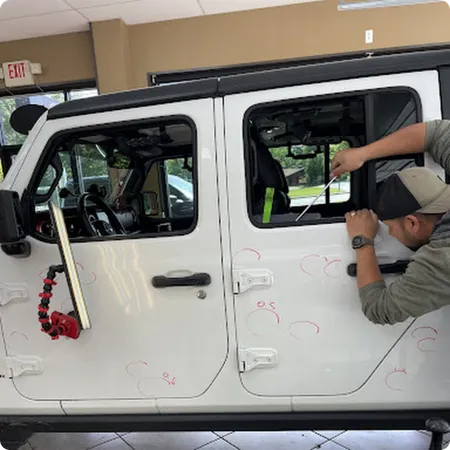
The process starts with access. To work a crease from behind, the technician needs to reach the back side of the panel. On a door, that usually means removing the interior panel and any plastic clips or wiring holders that block the work area. On a hood or fender, access points vary by make and model. Some modern vehicles have very little clearance behind certain panels, which can limit what tools a technician can position effectively. When access is tight, specialized rods and picks of different lengths and tip profiles allow work through small openings.
Once inside, the technician uses a combination of pushing from behind and tapping from the front to move the metal. The sequence matters. Starting at the ends of the crease and working toward the center prevents the fold from tightening as it closes. Each pass is small and deliberate. Rushing the metal forces it into a new distortion rather than releasing it back to its original shape. Reflective lighting, typically a special LED line board, sits in front of the panel so the technician can read every contour change in real time as the metal moves.
Not every crease is a PDR job, and being honest about that boundary is part of what separates a skilled technician from one who will attempt anything and deliver a disappointing result. When the paint has cracked, when the metal has been folded sharply at a tight angle over a long span, or when the crease sits directly on a character line pressed into the panel's design, conventional body repair is sometimes the more practical path. That doesn't mean failure — it means the right tool for the actual problem.
The cases where PDR genuinely shines on creased metal tend to share a few traits. The crease is shallow, the paint is solid, the affected panel has reasonable access from behind, and the fold doesn't sit directly on an existing styling ridge. Parking lot scrapes that leave a crease along the door edge often fall into this category. So do minor collision marks on relatively flat panels. Understanding this helps you walk into an estimate with realistic expectations and the right questions ready.
Sharp, deep folds are the most common reason PDR isn't the right call. When a panel takes a strong, focused impact, the metal at the crease apex can thin out and stretch. Stretched metal doesn't spring back the way elastically deformed metal does — it has been permanently altered at a material level. Thinned metal at a crease apex may crack or ripple when a technician attempts to move it, which would leave the panel worse than it was before any work began. An experienced technician identifies this condition during the inspection and will tell you upfront rather than attempt a repair that won't hold.
Paint cracking along the crease line is the other clear stopping point. Even a hairline crack in the clear coat means moisture and oxygen are already in contact with the primer beneath. If the metal is moved without addressing the paint, that crack opens further, and the repair creates a rust risk that wasn't there before. Any visible paint damage at the crease means the job belongs with a body shop, where the panel can be properly refinished after the metal work is done. The two approaches aren't competing — they cover different damage profiles.
Start by cleaning the area before your appointment. Dirt and wax over a crease make it harder to read under inspection lighting, and a clean panel gives the technician an accurate picture of paint condition from the first look. You don't need a full detail — just wash the panel and dry it. Removing any adhesive trim or door edge guards near the crease helps too, since those can hide paint damage at the very edge of the fold. A few minutes of prep saves time during the evaluation and gets you a more confident answer.
Bring photos of the damage taken in good natural light, ideally from multiple angles. A straight-on shot often flattens a crease and makes it look shallower than it is, while a low-angle shot with raking light shows the true depth and length. Photos taken in direct afternoon sun work particularly well for showing paint cracking that might not be obvious in flat, overcast light. If the crease happened in a collision and you have insurance involved, document everything before any work begins — your photos protect you through the claim process.
Creased metal sits in an interesting middle ground in the world of paintless dent repair. It isn't the easiest work a technician does, but it also isn't automatically out of reach for the process. Depth, paint condition, access, and the technician's skill level all combine to determine whether the crease comes out cleanly without touching the factory finish. Many creases that look serious to the untrained eye turn out to be very good candidates for PDR once a proper inspection happens under the right lighting.
The honest answer to whether PDR can fix your specific crease is: it depends, and an in-person look is the only way to know for sure. Trying to answer that question from a photo or a general description leads to guesswork. What doesn't require guesswork is finding a shop where the technicians will tell you the truth about what the damage needs rather than simply selling you the service they prefer to perform. That kind of straightforward approach protects your vehicle and your budget at the same time.
Precise Dent Repair
Paintless Dent Repair & Vehicle Hail Repair
Stay Current on Dent Repair
Get new articles on paintless dent repair and hail damage delivered straight to your inbox.
Stay Current on Dent Repair
Get new articles on paintless dent repair and hail damage delivered straight to your inbox.
Contact Info
Service Hours
Social Media
Mon-Fri: 8:00AM - 5:00PM
Saturday: Closed
Sunday: Closed



Licensed & Insured
Connect With Our Socials
Contact Info
Service Hours
Mon-Fri: 8:00AM - 5:00PM
Saturday: Closed
Sunday: Closed
Social Media
Licensed & Insured
©2026 Precise Dent Repair
Powered by: Customers Plus
Powered by: Customers Plus
Powered by: Customers Plus